
Chronic and Persistent PainTwo ways to work together.
A single session for an acute or specific problem, or a structured 12-week programme for pain that keeps coming back. Both begin with the same principle: your nervous system can change.
Single Session · EUR 95 · 60 minOne session. A first step.
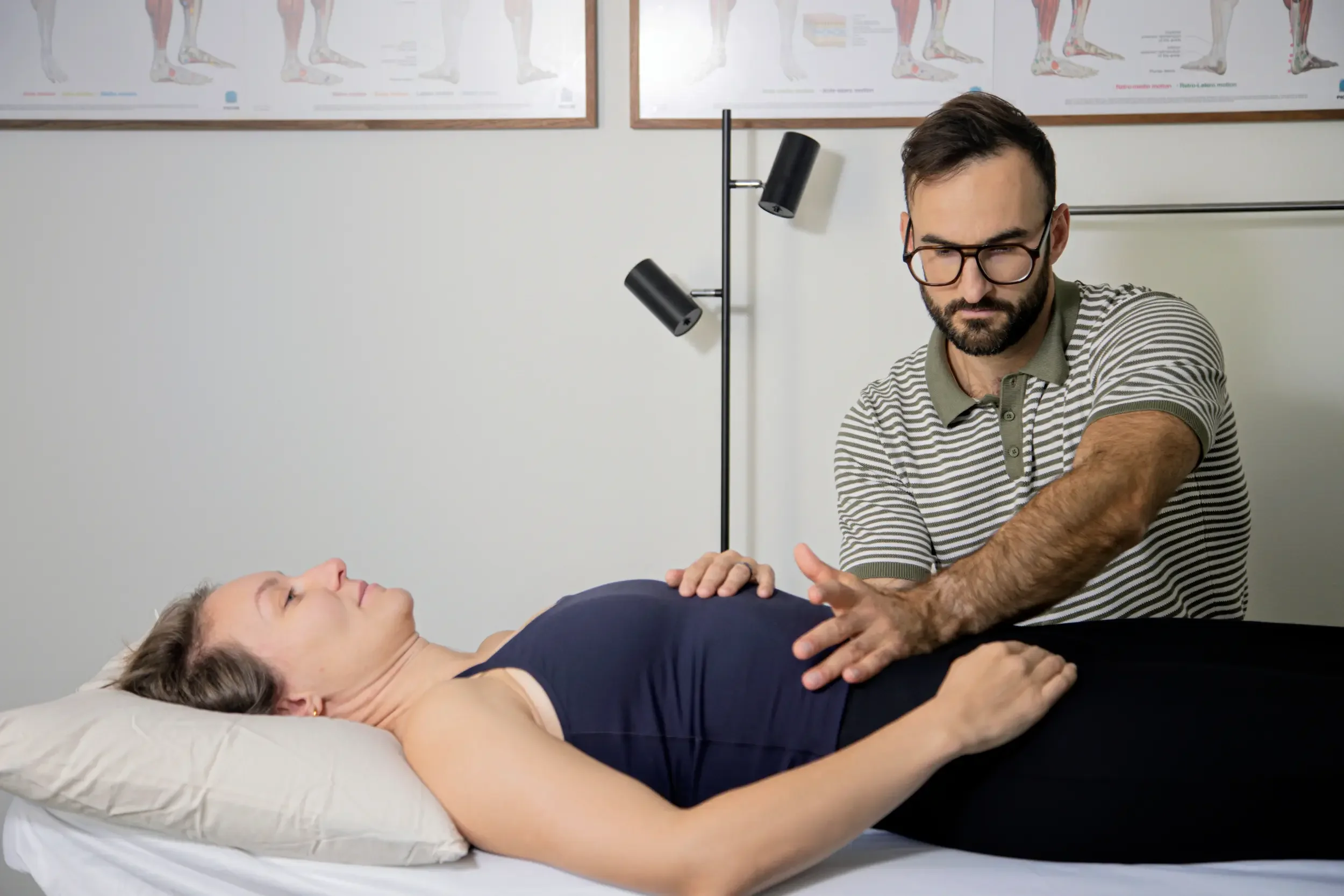
A hands-on session that can lean toward osteopathic manual therapy, movement and personal training, or a mix of both (depending on what you need). This is the right door for acute pain or a specific musculoskeletal problem, and for people who have finished the programme and want occasional maintenance.
Step 1Client Intake
Before we meet, you fill in a short intake form covering your pain history, what makes it better or worse, what you have already tried, and what matters most to you.
-
The intake form takes about 10 minutes. It helps me come in prepared so we spend our 60 minutes on treatment and understanding, not admin. You will also receive a brief overview of what to expect from the session.
Step 260-Minute Session
We start with a short conversation to clarify what you want from the session. Then a movement assessment and hands-on osteopathic treatment, finished with an explanation of what I found and what it means for you.
-
Sessions are available in-person in Turku (osteopathic manual therapy) or online (movement coaching and pain education). If you are unsure which format fits you, the intake form will help clarify that.
Step 3Next Steps
At the end of the session, you leave with a clear picture of what is driving your pain or limitation, and what to do next: a few exercises, a lifestyle adjustment, or a return visit.
-
There is no written report after a single session. What you get is a direct, plain-language explanation in the room: what I found, what it means, and what will actually help. If your pain turns out to be the persistent kind, I will tell you so, and the right next step is a consultation rather than another session.
Ready to book a session?
12-Week Programme · The Compass ProtocolA structured path out of pain.
A twelve-week programme for people whose pain keeps coming back. We rebuild what your body can do, by combining hands-on treatment, modern pain science and strength training in one place and measuring the change, so you can get back to the things pain has taken from you.
Most people arrive here having been passed between an osteopath and a trainer. Treatment stops at pain relief; training starts only once the pain is gone; and you are left to cross the gap in between on your own. That gap is where people fail. Here it does not exist, because the same person takes you across it.
Who it is for: People whose pain has lasted longer than three months and no longer makes sense as a tissue injury: pain that moves around, flares with stress as much as with movement, came on during a difficult period in life, or keeps going long after scans came back normal. Pain that seems to have a life of its own.
Before we beginFree Consultation
In this 45-minute consultation, we talk through your history. I give you my honest read on what is driving your pain and whether this programme is the right fit. You leave with it in writing, whether or not you go further.
-
You leave the consultation with a written page: what I think is driving your pain, the result of the screening, and what the three phases would look like for you specifically.
That page is yours to keep and to show to anyone else, including your doctor or your partner, whether or not you decide to work with me.
If you want a place, I hold it for one week.
-
The screening includes an assessment of whether your pain has a neuroplastic origin.
If the picture points to a primarily structural or medical cause, you will be referred to the appropriate specialist for medical intervention rather than continuing into the programme.
To support the assessment, bring any relevant medical documents you have: blood work, MRI reports, imaging, or previous clinical notes.
Week 1 · IntakeIntake Session
A full history, movement analysis, and the first hands-on treatment, 75 minutes. The same session: three validated questionnaires plus a strength and movement baseline, on a single page. Re-run identically at weeks 6 and 12.
-
Three instruments carry it.
The Patient-Specific Functional Scale, where you name three activities you cannot currently do and rate each one, so what we measure is your life rather than a generic score.
The Tampa Scale of Kinesiophobia, which measures fear of movement.
The Pain Self-Efficacy Questionnaire, which measures confidence in functioning despite pain, and is one of the stronger predictors of outcome in the research.
Alongside those, one repeatable strength number and one movement test. Measured at weeks 0, 6 and 12.
-
Somewhere in the first month, most people have a flare. It feels like proof that this is not working, and it is the single most common reason people quit.
So before anything else happens, I write down for you when it is likely to come and what it means, and you keep that page.
When it arrives as predicted, it is evidence that the model is right rather than evidence that you are failing. That is also the week we stay closest in touch.
Phase 1 · Weeks 1 to 4REGULATE
Calming an overactive nervous system with osteopathic manual therapy and breathing work. Load starts in week two, not at the end.
-
Osteopathic manual therapy (OMT) is hands-on treatment applied to the muscles, joints, connective tissue, and nervous system.
In this phase, the focus is not on fixing a structure but on calming the system: releasing tension patterns, restoring mobility, and sending the body clear signals of safety through touch and movement.
-
Persistent pain keeps the nervous system in a high-alert state. Between sessions, breathing techniques, body-awareness practices, and sleep and recovery habits are used to reduce that baseline arousal.
These are not relaxation exercises for their own sake. They are direct inputs into a system that has learned to stay on guard, and they compound over weeks.
-
Most programmes keep load until the end, as a reward for getting better. I do the opposite, because loading your body safely with someone qualified in the room is not the reward, it is the evidence.
In week two you do something that is unmistakably training rather than rehab, chosen by working backwards from the three activities you named on your scorecard.
And because the pain you are really afraid of is tomorrow's, not today's, you hear from me the next morning.
Either nothing happened, and you now have dated, witnessed proof that loading your body was safe, or something did, and I am there for it on the day rather than at next week's session.
Phase 2 · Weeks 5 to 8REWIRE
Using Pain Reprocessing Therapy to work directly on the brain's learned pain pathways. The false alarm patterns that keep pain alive long after any tissue injury has healed.
-
Pain Reprocessing Therapy (PRT) is an evidence-based approach developed specifically for persistent pain that the brain is generating as a false alarm.
Through structured techniques, you learn to observe pain signals with curiosity rather than fear, which gradually changes how the brain interprets those signals.
A landmark 2021 randomised controlled trial showed that 66% of participants were pain-free or nearly pain-free after four weeks of PRT. It is one of the most rigorously studied approaches in the field.
-
Many people arrive holding a scan report that says something is wrong with them.
That piece of paper is often the single biggest obstacle to recovery, and it deserves a proper conversation rather than being talked around.
We sit down with it, go through what the findings do and do not predict about pain, and look at what the research says about how often the same findings appear in people with no pain at all.
This is a defined part of the programme, not something that comes up by accident.
-
As the nervous system calms and the brain's relationship to pain shifts, movement capacity expands.
Load progresses week by week, built around the activities you named at the start. Osteopathic manual therapy continues as needed to support what is happening in the movement work.
Phase 3 · Weeks 9 to 12EMPOWER
Progressive strength and movement training to rebuild the physical capacity and confidence your body needs to return fully to the activities that matter to you.
-
The nervous system is calmer and the brain's pain response is shifting. Now we build on that with real physical load.
Progressive strength training means systematically increasing what you ask of your body over time, in a way that reinforces the nervous system's new understanding that movement is safe.
This is not generic gym programming. It is built around your specific goals, your history, and what your body is ready for at this point in the process.
-
Whether you want to run again, lift, play with your kids, or simply walk without thinking about it, this phase is where that return becomes concrete.
The three activities you named on your week 0 scorecard are the target, and the work is chosen to reach them. We move from general capacity to the specific things your life actually requires.
-
The final weeks are spent building toward independence.
You leave with a written maintenance plan: the exercises, habits, and self-regulation tools that keep you moving well on your own.
The programme is designed to end with you standing on your own.
Between the SessionsWeekly Check-in
Three to five minutes a day, chosen by your morning pain level. One check-in a week, on a fixed day, started by me. You never have to be the one who reaches out.
-
One printed card, and the same thing as a photo on your phone. You check how your pain is this morning and read one line.
High: the tools for a bad day.
Low to moderate: the somatic and breathing work.
None: the behavioural layer, sleep and screens. Three to five minutes.
Nothing to open, nothing to decide, nothing to remember. Programmes fail at home because they ask for twenty minutes and a decision from someone who has neither.
-
Every week, on the same day, I send you a short voice note or email, whichever you prefer. You answer when you have a moment.
It happens whether the week went well or badly, and it is always me who starts it, which matters: the week you most need to say something is the week you are least likely to pick up the phone.
Plus a message the morning after any session where we did something new with load.
Week 12 · ClosingDischarge Session
Your scorecard re-run a third time and set beside the week 0 and week 6 pages. We review what changed, what tools you leave with, and whether any further support makes sense.
-
The discharge session re-runs the same measures from weeks 0 and 6.
We look at the three pages side by side, review what shifted over the twelve weeks, and talk honestly about where you are now versus where you started.
The goal is that this session is a send-off, not a transition to more treatment.
After the programmeMaintenance Plan
You leave with a written plan: the exercises, habits, and self-regulation tools that keep you moving well independently. The goal is that you no longer need to come back.
-
Some people find an occasional single session useful for a period after the programme ends, not because they need ongoing treatment, but because a periodic touchpoint helps as they return to full activity.
Those are booked at the single-session rate and are not part of the programme. The plan you leave with is designed to work on its own.
Your investment2 400 EUR
Deposit-led: 400 EUR to begin, 1 000 EUR at week 4, 1 000 EUR at week 8.
Also included in the 12-week programFour things included beyond the sessions
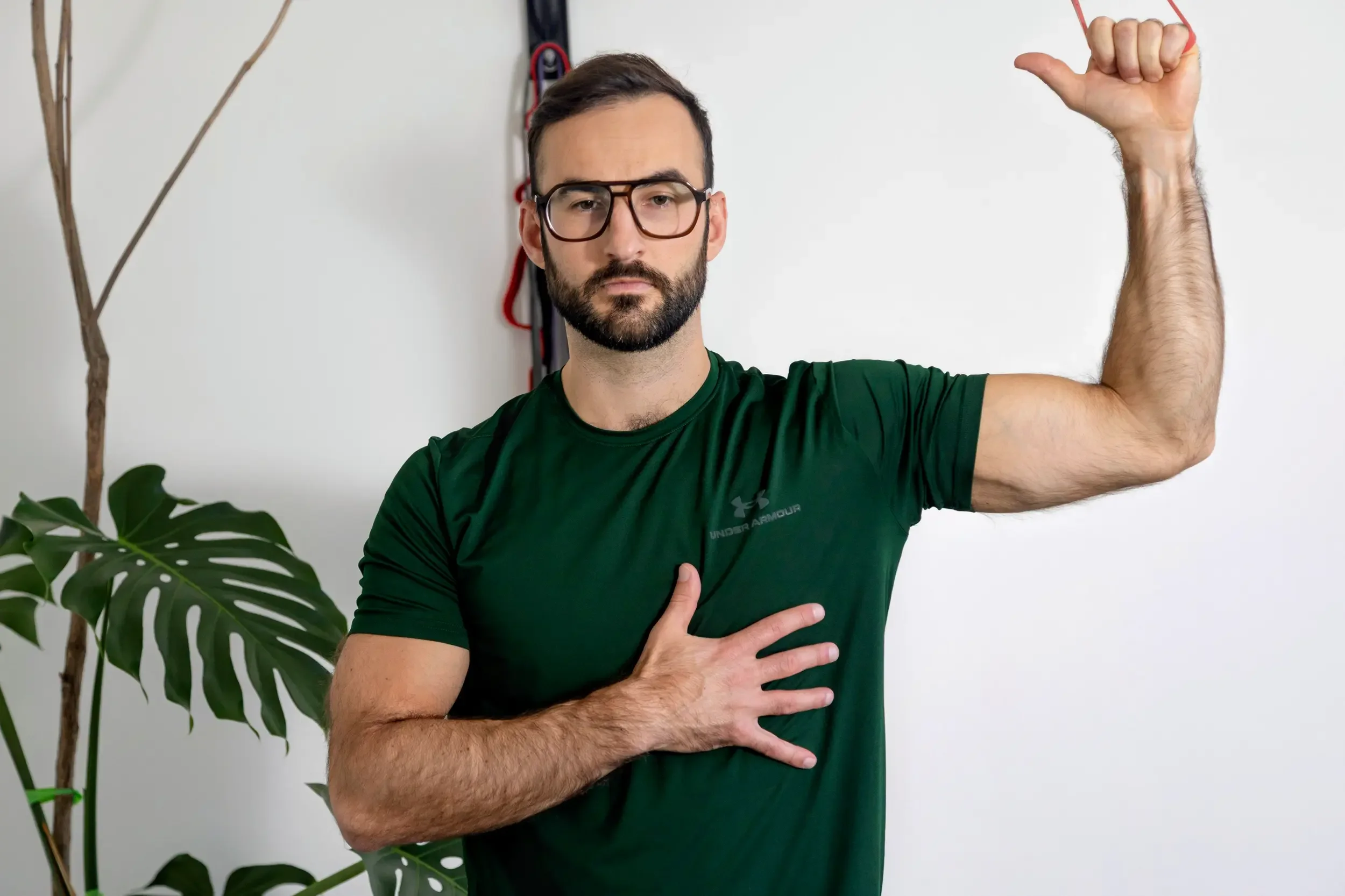
A sleep reset, a guide for your partner and a seat for them in any session, a plan for the twelve weeks after this one, and a free re-check six months after you finish.
Added bonusThe Sleep Reset
A guided non-sleep deep rest recording and a short written sleep protocol. Sleep is disturbed in almost everyone with persistent pain, and it is not something twelve weekly sessions can fix on their own.
Added bonusPartner Guide
One page explaining what is happening in your nervous system, what helps when you flare, and what not to say. Your partner is also welcome to join any one of your twelve sessions, at no extra cost, and to see your numbers for themselves.
Added bonusThe Next 12 Weeks
A written plan for what you do after you leave, built from the activities you named at the start and the point your training reached. Where it fits, that includes a named introduction rather than just an address.
Added bonus6-month Re-check
Thirty minutes, free, half a year after you finish, where we re-run your scorecard. Mostly it is reassurance. Occasionally it catches something early.
Money-back guaranteeIf it does not work, you do not pay for it
I cannot promise you will get better. Nobody honest can. What I promise is this: complete the twelve weeks, do the work, and if your own numbers have not moved, you do not pay for it, and I will help you find someone who might.
In full: attend all twelve sessions, complete all three scorecards, and use the daily card on at least half the days. If by week 12 none of the three activities you named at the start has improved by at least three points, you get a full refund and I arrange a referral. Illness is rescheduled inside the twelve weeks, not counted against you.
Common questionsBefore you book
Honest answers to the questions I hear most often.
-
Persistent pain that no longer makes sense as a tissue injury tends to show a recognisable pattern. Some signs worth paying attention to: your pain has been going on for more than three months; the usual treatments (physio, massage, injections) gave temporary relief at best; your scans came back normal or showed "nothing serious"; the pain seems to move around or change location; stress, sleep, or your emotional state clearly affects it; it came on or got much worse during a difficult period in your life (a loss, a major transition, prolonged pressure); or fear of movement is now limiting you as much as the pain itself. If several of these sound familiar, the free consultation is the right place to find out more. It is free, there is no obligation, and I will give you my honest read in writing.
-
Two reasons. First, most conventional treatment focuses on the tissue, which makes sense for an acute injury but not for pain that has lasted months or years, where the nervous system is involved. Pain Reprocessing Therapy works on the brain's learned pain pathways; osteopathic manual therapy calms the autonomic nervous system; progressive load rebuilds the confidence and capacity your body needs. Second, and just as important: nobody hands you off. Most people in your position have been passed between a clinician who stops at pain relief and a trainer who only starts once the pain is gone, and have been left to cross the gap between them alone. That gap is where people fail. Here it does not exist.
-
Pain is always produced by the brain. That is not a criticism; it is how pain works. The brain takes signals from the body, weighs up how much danger it thinks you are in, and decides how much pain to create. In persistent pain, this system gets stuck in a high-alert loop: the brain keeps producing pain as a protective signal, even after the original injury has healed, because it has learned to treat normal sensations as threatening. This is sometimes called neuroplastic pain, because the nervous system has become "plastic" in the wrong direction. It has learned something that no longer serves you. The good news is that what the nervous system has learned, it can also unlearn. That is what the programme is designed to do.
-
It is a promise about your money, not about medicine. At the start you name three activities that pain has taken from you, and rate each one. We measure them again at weeks 6 and 12, alongside two other validated questionnaires. If you attend all twelve sessions, complete all three scorecards, use the daily card on at least half the days, and by week 12 none of your three activities has improved by at least three points, you get a full refund and I arrange a referral to someone who may fit better. Three points is roughly the smallest change that counts as clinically meaningful on that scale, so the bar is a real one rather than a technicality. If you are ill, the session is moved, with up to four extra weeks if needed, and it does not count against you. A session missed without telling me does count as not attended.
-
If you need to move a session, tell me at least 24 hours before and we find another time within the programme. If you miss a session without telling me, there is no fee, but the session is not replaced or refunded. If you are ill, tell me as soon as you can, even on the day. The session is moved, and the programme can run up to four weeks longer if needed. If illness or injury keeps you out for longer than that, we pause, or you can stop and I refund the sessions you have not had. You can also stop at any time, for any reason, with a short email. The first 400 EUR is not refunded once your intake session has taken place. After that, each session counts as 200 EUR: you pay for the ones you have had or missed without notice, I refund the rest within 14 days, and later payments are cancelled. The guarantee applies only if you complete the twelve weeks.
-
No, and anyone who says that is not being honest with you. What I can promise is a thorough assessment, a clear explanation of what is driving your pain, a programme built specifically around you, and measurement you can check yourself at weeks 0, 6 and 12. The guarantee is not a promise about your body. It is a promise about my fee: if your own numbers have not moved, you do not pay for it.
-
You probably will, and I will have told you so in writing in week one, along with roughly when. A flare in the first month is the most common point at which people quit, because it feels like proof that nothing is working. It is not. It is the expected signature of a nervous system being renegotiated, and the fact that it arrives when predicted is a reason for confidence rather than alarm. You also have a written flare guide from day one, telling you exactly what to do on a bad day, and the weekly check-in means I come to you rather than waiting for you to get in touch.
-
Partly. Osteopathic manual therapy and supervised load require in-person sessions in Turku, but Pain Reprocessing Therapy, movement coaching, and the between-session support are all fully available online. A hybrid format works well for people who are not based in Turku full-time or who have travel constraints: in-person when it matters most, online for the rest.
-
You leave with a written maintenance plan and a plan for the twelve weeks after that: what you do, where, and at what load, built from the activities you named at the start. Six months later there is a free thirty-minute re-check where we re-run your scorecard. Beyond that, some people book an occasional single session as they return to full activity. That is available but not expected. The programme is designed to end with you standing on your own.
-
I work with a maximum of 8 people in the programme at a time. Two places open each month, starting on the first Monday. The first intake is January 2027. The free consultation is the right first step: it lets us both assess fit, and if you want a place I hold it for one week. If I cannot see you within two months, I will say so and refer you on rather than leave you waiting.
-
Not for persistent pain, and I would rather explain why than take your money. One session cannot resolve pain that has been building for years, so a trial session would not tell you whether the programme works. It would only tell you how one appointment feels, which you have probably already learned several times elsewhere. The free consultation exists for exactly this reason: you get my honest read in writing, and a clear picture of what twelve weeks would involve, before any money changes hands. Single sessions remain the right choice for acute and musculoskeletal problems.
-
No referral is needed. You can book directly. If you have imaging or medical reports from previous consultations, it is helpful to bring them, but not required. The intake session is comprehensive enough to build a clear picture of what is going on.
-
No. This is not covered by Kela or standard private insurance. I can provide documentation for any claim on request.
Limited availabilityTwo places a month
I work with a maximum of eight people at a time, because the programme does not work if I am spread thinner than that. Two places open each month, starting on the first Monday. The first intake is January 2027. After the consultation I hold your place for one week. If the wait would be longer than two months, I will tell you so and refer you on, and you keep the self-management tools either way.